Colour Code Wiring in Canada (CEC):
A Homeowner’s Guide
(and When to Call an Electrician)
Electrical wire colours aren’t random; they’re a built-in safety system. When wires are correctly identified, electricians can troubleshoot faster, upgrades go more smoothly, and the risk of mistakes drops dramatically.
If you’re a homeowner or business owner in BC and you’ve ever opened a panel cover, changed a light fixture, or wondered “what does that wire do?”, this guide will help you understand Canadian wiring colours at a high level, without turning it into a DIY project.
In British Columbia, electrical work is governed by the BC Safety Standards Act, overseen by Technical Safety BC. When in doubt, the safest (and often cheapest) move is to bring in a licensed electrician.
Important safety note: any wire can be energized
Even “neutral” and “ground” wires can carry current under certain conditions. Treat every wire as live and dangerous unless a qualified electrician has confirmed otherwise.
Canadian electrical wire colours (quick overview)

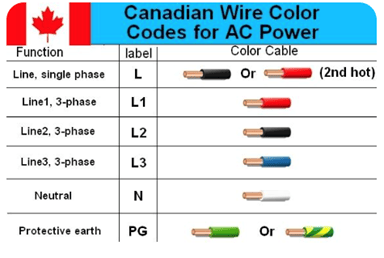
In most Canadian residential wiring (CEC), you’ll typically see:
- White = Neutral (with important exceptions)
- Green (or green/yellow) or bare copper = Ground/bonding conductor (safety path)
- Black / Red / Blue (and sometimes Yellow) = Hot (live) conductors
Below is what those colours generally mean in the home.
Black wires: the primary “hot” (live) conductor
Black wires are most commonly used as the main hot wire in typical household circuits. These conductors deliver power from the electrical source to switches, receptacles (outlets), and equipment.
Why it matters to you:
- Hot conductors are the ones most likely to cause shock if contacted.
- Many electrical issues – tripping breakers, dead outlets, flickering lights – trace back to problems on hot conductors or their connections.
Red wires: hot wires for specific applications
Red wires are also hot (live) and are commonly used where a circuit needs an additional hot conductor, such as:
- Certain switch legs (for example, some ceiling fan/light configurations)
- Interconnected hardwired smoke alarms (common use case)
- As a second hot conductor in 240V / 220V installations (depending on the system design)
Practical takeaway:
- Seeing red in a box often signals a “special purpose” circuit or multi-wire/switching setup—something you typically want a pro to verify before any changes.
Blue (and sometimes yellow) wires: hot conductors often used for switching
Blue wires (and sometimes yellow) are also hot conductors, frequently used in switching applications—especially where more than one switch controls the same light (like hallways or stairs), such as:
- 2-way / 3-way switching configurations
- Conductors run through conduit in some installations (conduit helps protect wiring from damage and corrosion)
Homeowner-friendly tip:
- Multi-switch circuits can be deceptively complex. If a light works from one switch but not the other, or you’re upgrading to smart switches, it’s worth having an electrician properly map the wiring.
White wires: neutral (but not always “safe”)
White is usually neutral in Canadian wiring. The neutral completes the circuit by carrying current back toward the source under normal operation.
Two key things to know:
- A neutral can still carry current and can still shock you.
- In some older wiring or certain configurations, a white wire may be re-identified (marked) to indicate it’s being used as a hot conductor.
If you see white wires that appear to be used for switching, or marked with black/red, that’s a strong sign you should have it assessed before making any changes.
Green / green-yellow (or bare copper): ground (bonding) for safety
Green (or green/yellow) and bare copper wires are grounding/bonding conductors. They’re there for safety: if a fault occurs (like a short), the grounding path helps reduce the risk of shock and helps protective devices (like breakers) trip as intended.
Important nuance:
Grounds don’t normally carry current in everyday operation. Treat them with respect. But they absolutely can during a fault condition, such as when the appliances and lights in the home are affected.
What exactly is a hot or live electrical wire? A hot electrical wire is used as the initial power feed to a circuit and serves as the conductor of electrical current from the power source to the outlet where it is required.
They always carry electricity, so it is dangerous to touch a hot wire while a power source is feeding it. It goes without saying, but always bears repeating, do not touch a hot wire of any colour unless there is no connected and operating power source.
Note: Other hot Canadian wiring colours include red and blue wires, which serve functions other than powering outlets (see details below).
Red Electrical Wires = Hot
Not unlike black wires, red electrical wires are also used for hot wires, although they are primarily used for switch legs (like for a ceiling fan).
You’ll find red wires in use to power smoke detectors that are hardwired to your electrical system. More specifically, red wires are used as the second hot wire in 220-volt installations.
In Canada, wiring colours: 2 red wires can be linked together, and red and black wires can also be linked together.
Blue Electrical Wires = Hot (& sometimes Yellow)
Other hot wires include blue wires and sometimes yellow wires. These are generally placed in an electrical conduit.
What’s an electrical conduit, and why would blue and yellow wires be pulled through one?
Conduits are generally made of plastic or metal pipe and protect blue and yellow hot wires from corrosion or damage.
According to Canadian wiring codes, blue and yellow hot wires are not typically used for power outlets. They are generally used to power 2-way or 3-way switches, where multiple switches control hall lights or stair lights, for instance.
White Electrical Wires = Neutral
White wires are usually neutral wires in our Canadian wiring colours. But what does this actually mean?
In our Canadian wiring codes, a neutral wire is used to complete an electrical circuit.
The hot wire will initialize the circuit, but once the current is flowing, another wire is necessary for the circuit to fulfill its intended purpose.
This is where the white, neutral wire comes in. The neutral wire will carry the circuit back to the power source, completing the AC current loop.
Don’t be deceived by the word ‘neutral’ though. Although an electrical current isn’t always passing through a white wire, you must handle this neutral wire with the same caution as when you handle a hot wire.
NOTE: Sometimes with older wiring, the electrician may have marked the white wires with red or black to show that the white wire is indeed hot.
Green Electrical Wires = Protective Ground (or Green/Yellow)
Green in Canada wiring colours means they are ground wires. When installed correctly, they carry no current.
Even though green typically indicates a ground wire, sometimes you’ll find that bare copper wire (without insulation) or a green wire with yellow stripes may be used.
What’s the purpose of an electrical wire that carries no electrical current? Safety!
Ground wires, also sometimes called earth wires, act to protect against an electrical current that may be unstable by taking errant currents out of the equation and ‘grounding’ them to the earth. If there’s a short circuit, ground wires redirect the excess electricity to prevent the risk of electric shock or electrocution.
To explain this in more specific terms: under normal conditions, when your electrical system is functioning normally and safely, the ground wire does not carry an electrical current.
However, if a short circuit or another anomaly occurs, the ground wire is there to conduct the unstable current to ground, neutralizing it.
Again, like white wires, just because your green ground wires don’t normally carry current, it doesn’t mean they never do. There will be current flowing through a ground wire while they deal with the overloaded system. Handle with care.
Canada Wiring Colours Recap

- Black = Hot wire, always carrying an electrical current.
- Red = Hot wire, always carrying an electrical current.
- Blue = Hot wire, always carrying electrical current, but pulled through a conduit and primarily used as a travelling wire for 2- or 3-way switch applications (to control one appliance or light using multiple switches).
- White = Neutral wire completes the electrical circuit.
- Green, Green/Yellow = Protective grounding wire, helps neutralize excessive electrical current when a fault occurs.
Wiring colours FAQ (homeowner version)
Which electrical wire colour is live?
Typically black, red, blue (and sometimes yellow) are live. White and green can also be energized in certain conditions, so don’t assume any wire is safe based on colour alone.
What colour is the ground wire?
Usually green, green/yellow, or bare copper.
What is a “hot” wire?
A “hot” wire is a conductor that delivers electrical energy from the source to a load (e.g., a light, outlet, or appliance). Contact with a hot wire can cause severe shock.
Don’t DIY electrical wiring (here’s why it costs more later)
Even if you understand wiring colours, electrical work can involve:
- Hidden damage in boxes or panels
- Incorrect past renovations
- Loose connections that can overheat
- Code compliance and permitting/inspection requirements
- Insurance complications if unlicensed work is discovered after a fire
If you’re renovating, adding circuits, upgrading lighting, installing EV charging, or are unsure what you’re looking at, it’s safest to involve a licensed electrician.
About Premium Electric
Need help in the Fraser Valley or Vancouver Lower Mainland?
Premium Electric’s certified, bonded electricians help homeowners and businesses with troubleshooting, upgrades, and code-compliant installations throughout the Fraser Valley and Lower Mainland of Vancouver.
If you have questions about wiring colours – or you want an expert to take a look – call 604-308-6195 or request a quote here: Contact Premium Electric
Last Updated on February 19, 2026 by Premium Electric